

 By
By Looking for the top SaaS trends in 2026? From AI-native platforms to automation-driven growth, this guide breaks down the key innovations shaping the future of software. Whether you’re a founder, marketer, or tech leader, these trends will help you stay ahead in the evolving SaaS landscape.
What once felt like a fast-moving start-up universe now resembles a dense, interconnected galaxy powered by AI, governed by regulation, and shaped by increasingly mature buyers.
In 2026, SaaS success is no longer defined by rapid feature releases or aggressive growth alone. Instead, it’s driven by intelligence, integration, efficiency, and trust.
This article explores the most important paradigms shaping the future of SaaS, helping founders, operators, and digital leaders understand where the industry is heading—and how to position their products for sustainable growth.
From SaaS Tools to SaaS Systems
Early SaaS products solved isolated problems. Modern SaaS platforms solve entire workflows. This evolution has pushed SaaS teams to rethink how their products connect with the wider ecosystem, making modern SaaS integration strategies a core requirement rather than a technical afterthought.
In 2026, buyers no longer evaluate tools in isolation. They evaluate how well a product fits into their existing stack, integrates with their data, and supports automation across teams.
This shift has elevated:
- API-first design
- Native integrations
- Embedded automation
- Event-driven architectures
SaaS products that fail to connect cleanly into broader ecosystems struggle to compete regardless of how strong their standalone features are.
The Rise of AI-Native SaaS
AI is no longer a feature, it’s an operating layer.
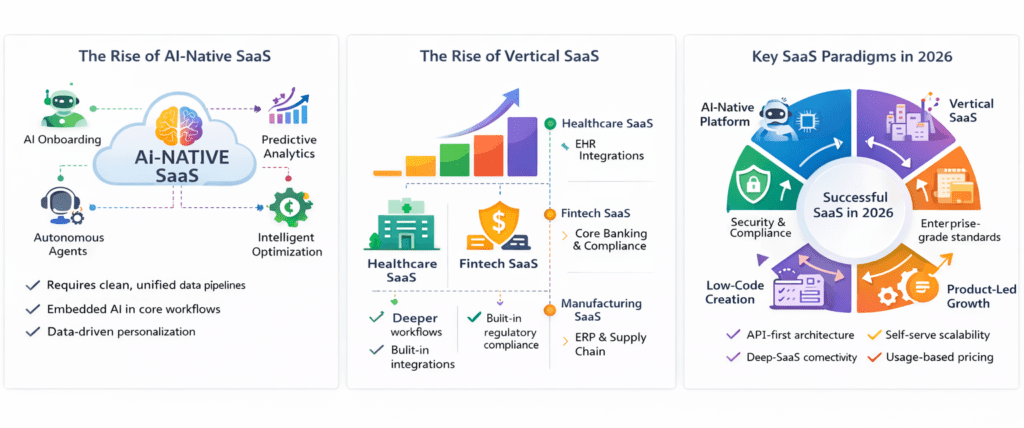
The next generation of SaaS platforms is being built as AI-native, not AI-enhanced. That means:
- AI-driven onboarding and personalization
- Predictive analytics baked into core workflows
- Autonomous agents handling routine operations
- Continuous optimization based on real usage data
Crucially, AI-native SaaS depends on clean, unified, and accessible data. This has made integration, data pipelines, and observability foundational not optional.
In 2026, SaaS platforms that cannot support AI-driven workflows are perceived as legacy products. The future of SaaS is a canvas of innovation and disruption, where traditional boundaries blur, and unprecedented possibilities emerge. As we hurtle toward this digital frontier, several key trends and predictions shape the landscape:
Low-Code, No-Code, and the Democratization of Software Creation
Another major paradigm shift is who builds software. Business users marketers, operators, analysts are increasingly empowered to create:
- Automations
- Dashboards
- Integrations
- Internal tools
Low-code and no-code platforms have reduced dependency on engineering teams while increasing speed and experimentation.
However, mature SaaS organizations have learned an important lesson:
Freedom without governance creates chaos.
The winning model balances:
- Empowered “citizen builders”
- Centralized guardrails
- Security, permissions, and observability
SaaS platforms that enable this balance gain a strong competitive advantage in enterprise environments.
Vertical SaaS Is Outpacing Horizontal Platforms
While horizontal SaaS dominated the last decade, vertical SaaS is accelerating faster in 2026.
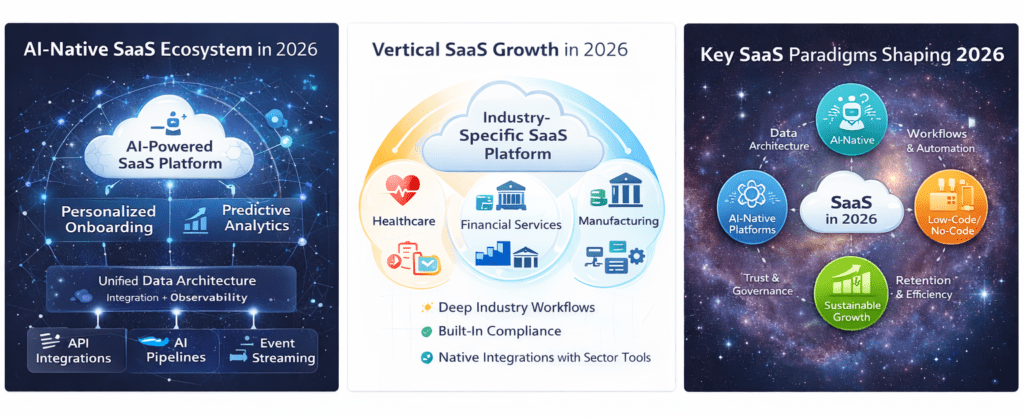
Industry-specific platforms now offer:
- Deeper workflows
- Built-in compliance
- Native integrations with sector tools
Examples include:
- Healthcare SaaS integrating directly with EHR systems
- Fintech platforms embedding compliance and core banking connections
- Manufacturing SaaS connected to ERP, IoT, and supply chains
For SaaS founders, this signals a shift from “build for everyone” to build deeply for someone.
Security, Compliance, and Trust as Growth Drivers
Security used to be a blocker. In 2026, it’s a growth enabler.
Enterprise and mid-market buyers increasingly expect:
- SOC 2 and ISO 27001 readiness
- GDPR and regional data compliance
- Transparent data handling policies
- Audit logs and access controls
SaaS companies that invest early in trust infrastructure close deals faster, expand accounts more easily, and reduce churn.
Trust is no longer just legal protection, it’s a competitive differentiator.
Product-Led Growth Has Matured
One of the biggest SaaS trends in 2026 is the increasing demand for seamless software integrations. As businesses adopt multiple cloud platforms, implementing strong SaaS integration strategies becomes essential for connecting tools, automating workflows, and improving operational efficiency. Product-led growth (PLG) isn’t new but it has evolved. In 2026, successful PLG strategies combine:
- Self-serve onboarding
- Usage-based pricing
- AI-driven in-product guidance
- Sales-assisted expansion for larger accounts
The product still leads but sales, success, and marketing now work in tighter alignment.
Pure “hands-off” PLG models are giving way to hybrid growth engines optimized for retention and expansion.
Data as the New Control Plane
Data is no longer just something SaaS products generate, it’s what they run on. As data becomes the control plane for modern SaaS platforms, many companies are rethinking their infrastructure, making cloud data migration a critical step toward AI readiness and real-time decision-making.
Modern SaaS platforms treat data as a control plane that powers:
- AI recommendations
- Customer health scoring
- Revenue forecasting
- Real-time decision-making
This has increased focus on:
- Cloud-native data architectures
- Real-time event streaming
- Unified analytics layers
SaaS products that cannot operationalize data struggle to scale intelligently.
The Shift From Growth-at-All-Costs to Sustainable Scale
Perhaps the most important paradigm shift is cultural. As the SaaS industry matures, growth is no longer about speed alone. Successful companies focus on sustainable, AI-driven scaling strategies that balance expansion with retention, efficiency, and long-term trust.
After years of aggressive expansion, the SaaS industry has matured. In 2026:
- Profitability matters earlier
- Efficiency is valued over headcount
- Automation replaces manual scale
- Retention is prioritized over raw acquisition
Sustainable SaaS businesses are built on systems, not heroics.
Final Thoughts
The SaaS galaxy is more complex than ever, but also full of opportunity.
For founders and operators willing to adapt, 2026 offers a chance to build:
- Smarter products
- More resilient businesses
- Deeper customer relationships
At SaaS Novas, we explore these shifts to help SaaS teams stay ahead of the curve not by chasing trends, but by understanding the systems beneath them.
👉 Explore more insights at www.saasnovas.com
1 Comment
Comments are closed.